


What happened?
Late Saturday, President Trump ordered US B-2 bombers and naval cruise missiles to attack Iran's nuclear sites in Fordow, Natanz, and Isfahan. This was coordinated with Israel's ongoing "Operation Rising Lion." Trump hailed the raid as an "overwhelming success," hinting at regime change if Tehran retaliates. Iran condemned the attacks, filed a UN protest, and considered suspending all cooperation with the IAEA. On Monday, Israeli jets hit an IRGC depot near Natanz and other symbolic, regime-linked targets in Tehran, including the notorious Evin prison. Brent crude oil prices spiked above $80 per barrel, the highest price since January.
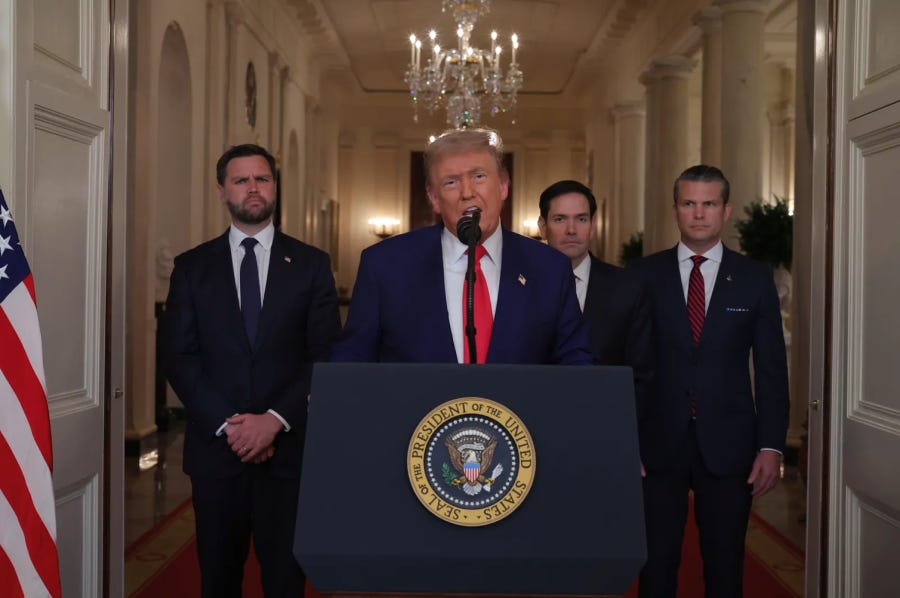
Source: Carlos Barria / EPA (Trump with Vance, Rubio and Hegseth)
Why does this matter?
Global implications: For the first time, the US has transitioned from deterrence to direct military engagement. This could unify Iran's fragmented political factions and escalate proxy attacks across the region.
Ripple effects: Although there are no immediate supply cuts, there is rising uncertainty surrounding the Strait of Hormuz, through which ~20% of the world's oil supply passes.
What's next?
Russia has hinted at expediting drone transfers to Iran while taking advantage of NATO's diverted attention. China is urging de-escalation yet quietly increasing its purchases of discounted Iranian crude oil. Neither Israel nor Iran has achieved sufficient strategic leverage to dictate terms, and the US strikes are a calculated show of force rather than an all-out war.
finformant view
Now that US forces are directly involved, the Israel–Iran conflict has become systemic, not just regional. A quick end to the war is unlikely. Instead, expect a prolonged confrontation involving elevated energy risks and increased coordination among rival powers.