



Ukraine is currently fighting along three fronts at once: against Russia along the front lines, against exhaustion in the rear, and against a mounting governance crisis in the capital. The latter may prove to be the most important. It’s not just a story of wartime fatigue or unpopular reforms anymore. Rather, it increasingly resembles a standoff between the presidency and parliament. The government remains loyal to the president, but appears unable to negotiate with lawmakers or convert presidential authority into legislation.
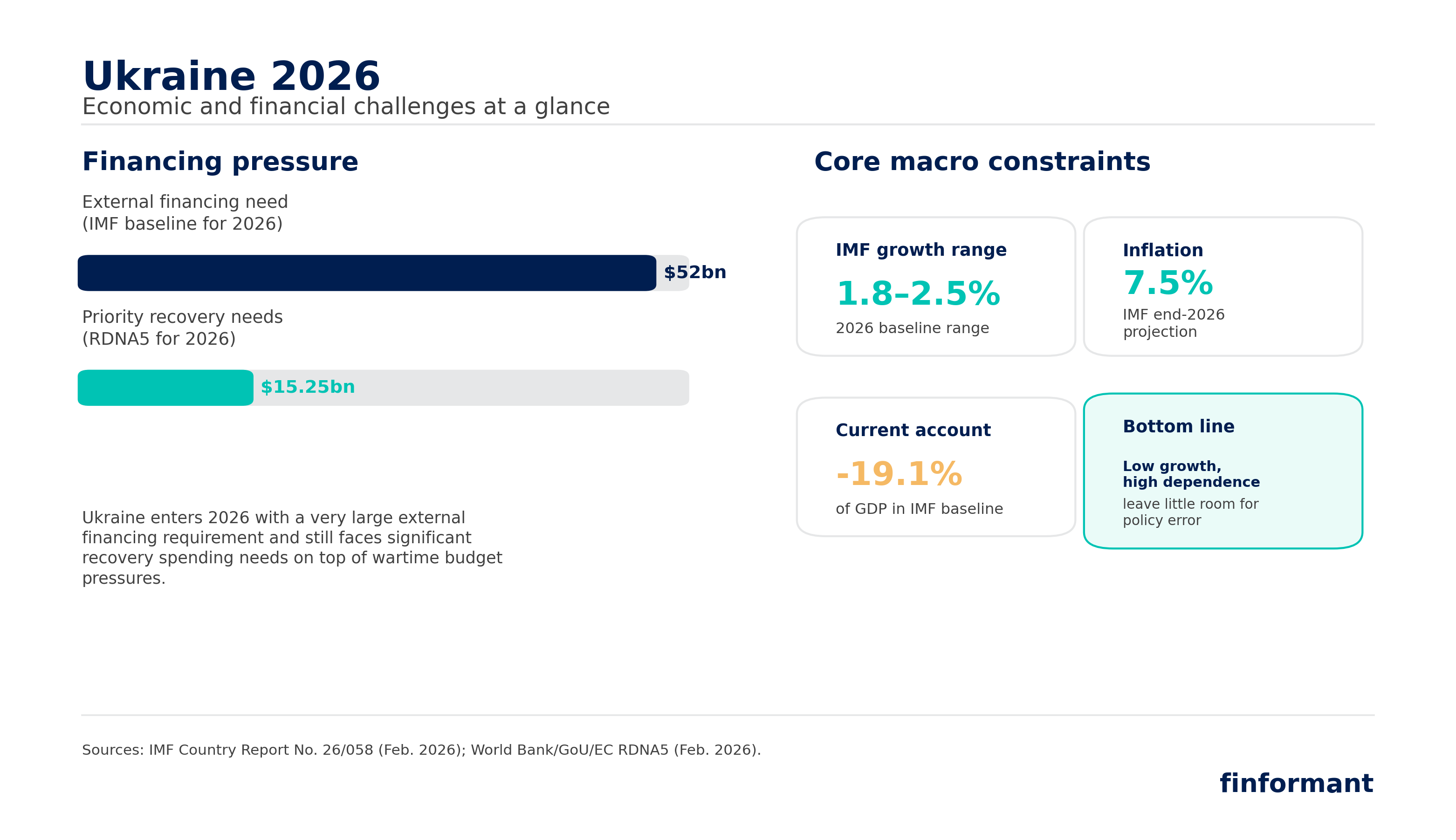
The immediate trigger is fiscal. On March 18, an IMF mission began talks with Ukraine as Kyiv struggled to pass unpopular tax measures tied to a new $8.1 billion program. Ukraine will require between $45 billion and $52 billion in external financing this year to cover its budget deficit. In a war economy where domestic revenue is largely consumed by defense, this is not a secondary issue.
Yet parliament is increasingly refusing to act as the presidency’s political shock absorber. On March 24, MP Zhelezniak said Ukraine would miss 25 end-of-quarter commitments under IMF, World Bank, and Ukraine Facility programs, placing around €7 billion at risk. He was unusually blunt: “During all this time, no one has even tried to solve the problem. There has been no communication from the government, nor has the president attempted to gather the faction to coordinate actions.” He added that many deputies in the presidential faction “no longer feel obligated to the president.”
That is the deeper story. Many parliamentarians do not see why they should take the blame for laws originating with a presidency whose authority has become politically costly and unstable. Meanwhile, the presidency still seems to govern as though executive command should automatically produce legislative obedience. It no longer does. The result is paralysis at a time when wartime governance requires political brokerage and competence, not just administrative discipline.
Attrition is now political as well as military
The military situation remains grim but not hopeless. Russia is still advancing, albeit slowly and at great expense. On March 16, Valery Gerasimov, Russia’s chief of the general staff, announced that Russia had seized 12 settlements during the first two weeks of March and was advancing “in all directions.” However, Ukrainian forces claim to have recaptured around 400 square kilometers and eight settlements on part of the southern front since late January, so this broader interpretation is not undisputed, and the situation on the battlefield remains mixed. Russia is making progress but is not achieving a decisive operational Ukrainian collapse.
This is precisely what makes Ukraine’s institutional deterioration so dangerous. Wars of attrition are not decided by who takes a village this week. They are decided by manpower, fiscal endurance, industrial depth, political cohesion, and a state’s ability to convert pain into organized action. Ukraine still shows tactical resilience. Yet it is unclear whether the country has the institutional resilience for a prolonged struggle.
The rear is also under growing pressure. Since Monday evening, Russia has launched nearly 1,000 long-range drones at Ukraine, including a significant daytime attack on March 24. This is a notable departure from Russia’s usual nighttime pattern. Zelenskyy quickly noted that the scale of the attack clearly shows that “Russia has no real intention of ending this war,” seemingly implying that a smaller number of fired drones would suggest otherwise. Ultimately, though, this matters not only militarily. Russia is demonstrating that it can continue to degrade daily life far from the front lines and force Ukraine to allocate its limited resources toward survival rather than rebuilding.
Iran exacerbates this situation in at least two ways. Firstly, a war involving Iran will divert U.S. air defense capacity away from Ukraine. A prolonged conflict could and is already reducing the availability of Patriot interceptors for Kyiv. Secondly, a war with Iran is helping Russia financially as the oil price surge has allowed Moscow to delay planned changes to its fiscal rule because higher energy revenues have eased the immediate pressure on state finances. In other words, the same Middle Eastern crisis that could weaken Ukraine’s air defense is improving Russia’s short-term war financing position.
There is a further implication. As Washington once again becomes consumed by military intervention and regime-change logic in the Middle East, Moscow is more incentivized to advance in Ukraine and end the war on its own terms. This is partly a straightforward wartime calculation: a United States engaged in a broader regional confrontation will have fewer resources, less focus, and less patience for Ukraine. The Kremlin’s decision to put peace talks on hold amid the war with Iran reflects this logic. However, there is also a political and emotional layer. To Moscow, the United States once again appears to be an overbearing, interventionist behemoth that asserts its interests by force while demanding restraint from others. This perception strengthens the Kremlin’s belief that it has the right and necessity to impose its will within its strategic sphere. The result is not a moment that encourages compromise but one that encourages Russia to press harder.
Europe’s support is fueled by fear
Europe is blunter in private than in public. In my closed-door conversations with German and European decision-makers, including diplomats and advisers to prime ministers, the underlying logic has been unmistakable: continued support for Ukraine’s military effort is increasingly viewed as a matter of self-preservation rather than solidarity. Europe fears that a Russian victory, or even a release of military pressure from Ukraine, would pose a direct threat to Europe itself. In December, Reuters clearly captured this logic: “Most EU countries believe that as long as Moscow is militarily engaged in Ukraine, it will not attack any EU countries, giving Europe time to prepare its defense.”
This logic helps to explain Europe’s current position. According to the Kiel Institute, U.S. aid allocations to Ukraine decreased by 99% in 2025 compared to the average from 2022 to 2024, while European military aid increased by 67%, and European financial and humanitarian aid increased by 59%. Europe has stepped up because it increasingly views Ukraine as a strategic buffer that it needs.
That strategy has a price. If Europe’s main goal is to maintain Ukraine’s ability to fight because Europe itself is not yet ready, then there is a strong temptation to overlook Ukraine’s coercive mobilization practices, democratic deficiencies, governance failures, incompetence, and corruption. Publicly, the rhetoric remains moral and ideological, pitting democracy against authoritarianism and victim against aggressor. This rhetoric is useful, but it also allows Europeans to avoid acknowledging their harder motive: time-buying self-interest.
The longer-term risk is that this approach may preserve Ukraine militarily while degrading its institutions. Europe is vehemently resistant to any suggestion of political convergence between Ukraine and Russia because it would complicate the moral clarity of its narrative. Yet, prolonged war, unchecked executive power, coercive wartime practices, and suspended accountability can produce dangerous forms of democratic decay. This would not be happening in isolation either: According to V-Dem, the current “third wave of autocratization” is deepening, with the average global citizen’s access to democracy regressing to roughly 1978 levels. Meanwhile, Freedom House reports that freedom has declined globally for the 20th consecutive year. Ukraine could become another case in this broader pattern—not a failed democracy in the conventional sense, but rather, a war-distorted state whose institutional weakening is steadily justified by external necessity. Such a country would be difficult to integrate into the EU.
States can fail strategically before they collapse tactically
The historical analogy is uncomfortable, but worth making. Germany did not lose the First World War because of one dramatic battlefield catastrophe that suddenly erased its army. Rather, it lost because the war exhausted its resources, weakened its social and political resilience, and overwhelmed its system. The same could happen to Ukraine. A country can fail strategically before it collapses tactically. It can resist, avoid a decisive battlefield defeat, and still lose the larger contest through depletion, fiscal strain, and institutional decay.
That is the real danger now. Ukraine may not lose because Russia achieves a spectacular breakthrough. Rather, it may lose because the state can no longer bear the total burden placed on it by Russia, the attritional logic of the war, and a European strategy that requires Ukraine to endure while increasingly overlooking the toll that endurance is taking on Ukraine itself.
The uncomfortable truth is that Ukraine could pose a medium- to long-term security challenge for Europe itself, even if it never falls under Russia’s control. If the current trends of militarization, coercive state practices, and democratic decay continue, the EU may eventually find itself facing a heavily armed, institutionally damaged, and politically volatile state on its border rather than a stable democracy forged by war. This risk is still far off, but it is real. Ignoring it now could make managing it much more difficult later.
finformant view
The Iran-Ukraine connection is more significant than many investors realize. Higher oil prices help improve Russia’s fiscal position in the short term, and a prolonged escalation in the Middle East will divert U.S. air defense and policy resources away from Ukraine. This combination modestly supports Russia’s external resilience, and it negatively affects the probability of faster or cleaner stabilization in Ukraine.
Ukraine-specific risk is no longer only a front-line variable. The bigger question is whether Kyiv can function as a wartime financing machine. If parliament continues to stall IMF- and EU-linked measures, investors and policymakers should anticipate greater volatility surrounding external disbursements, reform conditionality, and state capacity. This does not mean an imminent collapse. However, it does mean higher institutional risk premia surrounding any Ukraine-related reconstruction, sovereign exposure, or defense industrial project.
Europe’s self-interest is now the key anchor of support for Ukraine. This makes continued support more durable than a purely moral narrative would suggest, but it also makes Europe more likely to prioritize battlefield continuity over governance quality inside Ukraine. Hence, in addition to watching headlines about aid, markets should also watch for signs of institutional decay in Ukraine, such as legislative paralysis, fiscal slippage, mobilization backlash, corruption, and executive overreach. These are no longer side issues. They are becoming core variables in the war’s medium-term trajectory.