



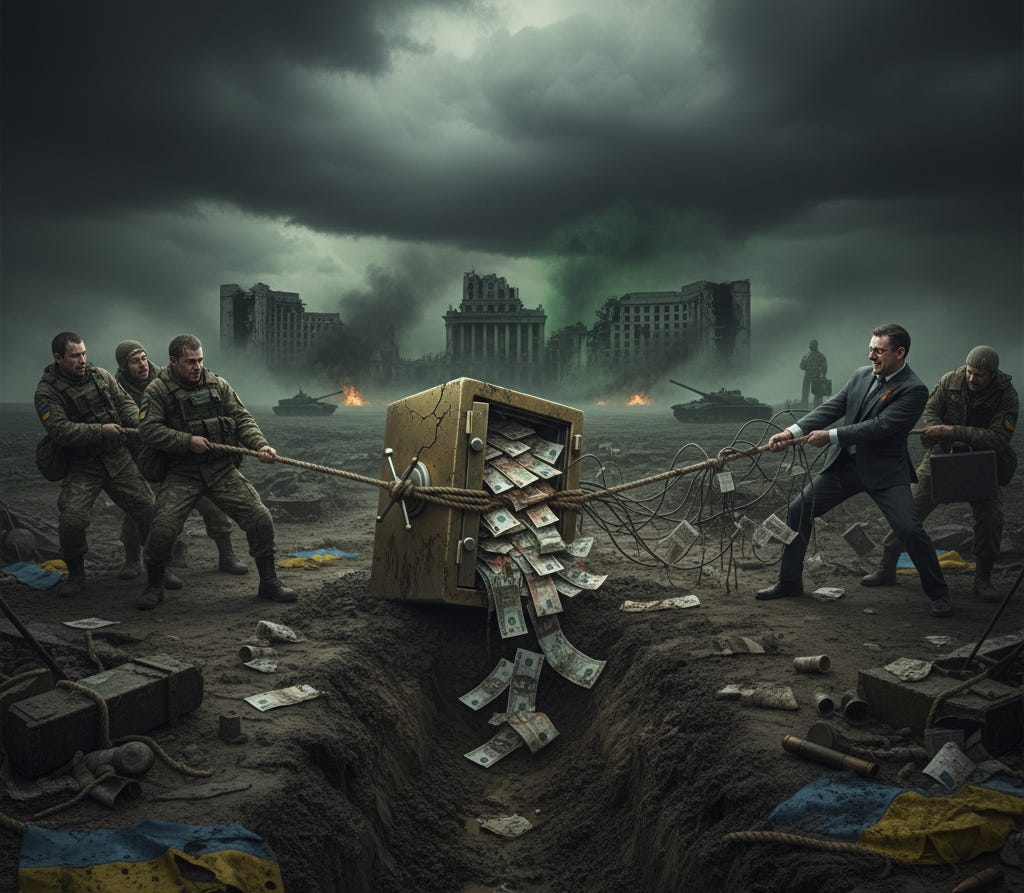
For once, the most dangerous news about Ukraine does not come from Pokrovsk or Zaporizhzhia; it comes from Kyiv’s ministries and boardrooms. The $100 million Energoatom corruption scandal is more than just another case of wartime graft. It reveals how Ukraine’s leadership has weakened institutions, obscured lines of responsibility, and made European support politically toxic—all while Russian forces advance across the eastern and southern fronts and Ukraine’s war effort deteriorates.
The question now is whether the current leadership is capable of fixing the mess or if it has become part of the problem that makes a Russian victory more likely.
This question is even more urgent when two uncomfortable realities are factored in:
On the other side of the front line, Russia’s economy is not on the verge of collapse despite triumphant declarations by many. Moscow is now spending roughly 7–8% of its GDP on defense and security (close to 40% of its federal spending) yet it has managed to keep the system functioning. It has done so by using higher taxes, redirected oil revenues, and a “guns over butter” social contract to finance the war for at least several more years, according to multiple independent estimates.
Meanwhile, inside Ukraine, the mobilization crisis is deepening. Since February 2022, prosecutors have opened over 50,000 desertion cases and more than 110,000 investigations for absence without leave (AWOL) in the first months of 2025. Desertion-related offenses now account for more than a fifth of all registered crimes.
Against this backdrop, the recent verdict of major wartime volunteer Sternenko is brutally concise: “Our defense is falling apart. The question of when Russian tanks will enter Zaporizhzhia or Dnipro is only a matter of time—all under a stunning silence about it.”
Operation “Midas” and the Mindich connection
The Energoatom case is straightforward and devastating. After a 15-month investigation, Ukraine’s National Anti-Corruption Bureau (NABU) and the Specialized Anti-Corruption Prosecutor’s Office (SAPO) revealed that intermediaries had allegedly skimmed 10–15% in kickbacks from Energoatom contracts. These contracts included those for protective structures around substations intended to shield energy infrastructure from Russian attacks. According to investigators, the network routed around $100 million through a criminal group that controlled procurement at the nuclear company.
Timur Mindich, a longtime business associate and co-owner of Zelenskyy’s former Kvartal-95 studio, is among those charged. He is accused of orchestrating the scheme and fleeing the country just before searches began.
Two ministers, Justice Minister Galushchenko (formerly Energy Minister) and Energy Minister Hrynchuk, resigned after Zelenskyy publicly demanded their removal. NABU released audio suggesting that Galushchenko and Mindich joked about the president calling during a group call related to the scheme. The tapes cut through the carefully built image of a reformist wartime president floating above corruption.
Zelenskyy has since imposed sanctions on Mindich and his associate, Oleksandr Tsukerma, an extraordinary move against a former business partner, and the government has dismissed Energoatom’s entire supervisory board, promising audits and a relaunch.
On paper, the anti-corruption system is working. NABU investigates, SAPO prosecutes, and ministers resign. Brussels dutifully points to this as proof that Ukraine’s watchdogs are functioning.
But this is the polite, official narrative. It misses the deeper problem.
Scapegoats, and the missing prime minister
The government’s response follows a well-rehearsed pattern: wait, deny, minimize, then fire a few ministers once the scandal becomes unmanageable. As more details emerged, Zelenskyy shifted from downplaying Mindich’s role to imposing sanctions and placing ministers on “temporary leave,” to ultimately demanding their resignations in a video address.
Almost no one in Kyiv believes that the responsibility ends with two ministers and a fugitive businessman.
At the political center of this story is prime minister Svyrydenko. Before assuming the role of head of government this summer, she spent years as economy minister and first deputy prime minister. In those roles, she oversaw the corporatization of Energoatom and the appointment of its supervisory board. That board included foreign independents and two state representatives, including Tymofiy Mylovanov, president of the Kyiv School of Economics and former economy minister.
Now that the scandal has broken, Svyrydenko is dissolving the very board she personally constructed. She has ordered an audit of all state-owned companies and insists that the supervisory board, not the cabinet, bears responsibility for Energoatom’s failures.
However, there is an even more uncomfortable reading of the situation:
As economy minister and then prime minister, Svyrydenko oversaw the structure that allowed this scheme to flourish.
She has also had long-standing ties to the Kyiv School of Economics, from which she received income (a substantial boost to her moderate ministerial salary) while Mylovanov, the school’s president, obtained a seat on Energoatom’s board as a state representative. Ukrainian media and MPs have repeatedly flagged this relationship as a conflict of interest and a de facto quid pro quo.
Mylovanov has now publicly been fired from Energoatom’s board (and from another major state defense holding), claiming that his proposals for anti-corruption oversight were ignored and that the company “did not wake up” even after NABU’s investigations.
While everyone is pointing the finger at someone else, Ukraine’s partners have a clear understanding of the situation: this mess happened under Zelenskyy’s management, in companies designed and overseen by his closest allies.
A gift to Moscow in a long war
The timing could not be worse.
On the battlefield, Russia is advancing around Pokrovsk, claiming “house-to-house” gains and partial encirclement. Meanwhile, Ukrainian sources are admitting to painful losses and describing the situation as “extremely difficult.” Independent mapping projects confirm Russian advances in the area, though Moscow’s propaganda exaggerates how close it is to achieving a full breakthrough.
Further south, in Zaporizhzhia, Ukrainian troops are engaged in what the Defense Ministry calls “exhausting battles” as Russian forces attack along the Orikhiv–Robotyne axis and attempt to push Ukrainian artillery out of the line of sight of key logistics routes. Although Ukraine has used drones to repel several recent assaults, the line is under constant pressure.
Strategically, this is a classic attritional moment, and the contrast between Russia’s war economy and Ukraine’s domestic situation is striking here.
Russia’s military spending surged by nearly 40% in 2024, reaching approximately $149 billion (roughly 7% of its GDP) and is expected to remain at this level in 2025–26. This level of spending is painful and unsustainable in the long run, but not a short-term death sentence. Economists at major institutes and the IMF now talk in terms of years, not months, of remaining fiscal capacity.
Ukraine, by contrast, spends about a third of its GDP on the military and depends on external financing for even basic social spending. While Moscow can still mobilize internal resources, albeit at the cost of slower growth and higher taxes, Kyiv’s budgetary survival depends on the goodwill of parliaments in Berlin, Brussels, and Washington, all of which are under mounting pressure from their constituents.
This fragile situation has now been further complicated by a scandal that, to European voters, reads like the worst cliché: $100 million in kickbacks skimmed from funds intended to protect substations and power plants from Russian missiles amid rolling blackouts.
Russian propaganda barely needs to work; it can simply translate NABU press releases and Western headlines and tell European taxpayers, “This is what your money pays for.”
The risk is not that Europe will abandon Ukraine overnight. Rather, the risk is that support will become slower, more conditional, and more politically costly, just as Kyiv needs a predictable, multiyear financial and military framework to stabilize the front and address rising desertion, fatigue, and economic exhaustion.
The “Ukrainian Practitioner” and the cost of devalued institutions
Behind the scandal lies a deeper institutional story.
In recent years, Zelenskyy and his team have personalized the system around the presidency. They have turned the cabinet, including the prime minister, into an extension of the president’s office rather than an independent center of policymaking. Svyrydenko’s appointment was based solely on loyalty and resulted in the tragic arrival of an incompetent bureaucrat.
As a result, key offices have been completely devalued. When prime ministers, ministers, and supervisory boards are viewed as interchangeable loyalists rather than as the foremost custodians of institutions, every scandal ends the same way: a few expendable individuals are sacrificed, the president distances himself, and everyone moves on until the next crisis.
This reminds me of when I advised the president on economic reform. Around 2020, a prominent partner and friend of the president, who had also been ousted in a scandal in 2024, insinuated to me that I wasn’t qualified to contribute to Ukraine’s development. According to him, the main skill of a real “practitioner,” as opposed to a mere “theorist,” was the ability to survive in jail. He believed that I was somehow less trained than he and his chosen officials in this special art form. According to him, their great comparative advantage was their ability to navigate prisons, prosecutors, and kompromat.
This mindset has culminated in the current system: a narrow circle of “practitioners” who take pride in surviving raids and investigations rather than building resilient institutions that prevent such scandals. It is no coincidence that Energoatom, corporatized and supervised by precisely this ecosystem of insiders, has become the emblematic case.
Ukraine’s partners quietly understand all of this. The conventional wisdom in Berlin, Brussels, and elsewhere is that pushing for a change in leadership during wartime is too risky. The argument is that any shock in Kyiv would open the door to Russian advances.
However, the emerging reality may be the opposite. Leaving a discredited, incompetent, and factionalized leadership in place could pose a greater risk. This approach erodes morale, undermines the legitimacy of mobilization and taxation, and makes it more difficult to justify the use of each new euro or dollar at home.
At some point, whether during or after the war, Ukraine will require a complete political and institutional reset, not just a reshuffle:
a genuine separation between presidency and government,
a rethinking of the prime minister’s role (towards a parliamentary “chancellery” model, including a “rebranding” to break with the degraded symbolism and historical memory of the current Zelenskyy office),
and real consequences for those who sat atop failing structures like Energoatom, not just for the middlemen who took the envelopes.
finformant view
The Energoatom and Mindich scandal is not “just another corruption story.” It is a symptom of the system Zelenskyy chose: one that centralized power, personalized loyalty, and treated institutions as stage props while Russia prepared for a long war, and Ukraine’s mobilization and economy were pushed to their limits.
Ukraine’s soldiers are buying time around Pokrovsk and Zaporizhzhia. Whether that time is used to clean out a deeply compromised ruling circle or merely to reshuffle scapegoats will reveal more about Ukraine’s future than any map of the frontlines this winter.